Published
- 5 min read
Contains Duplicate - a classic hashing warm-up
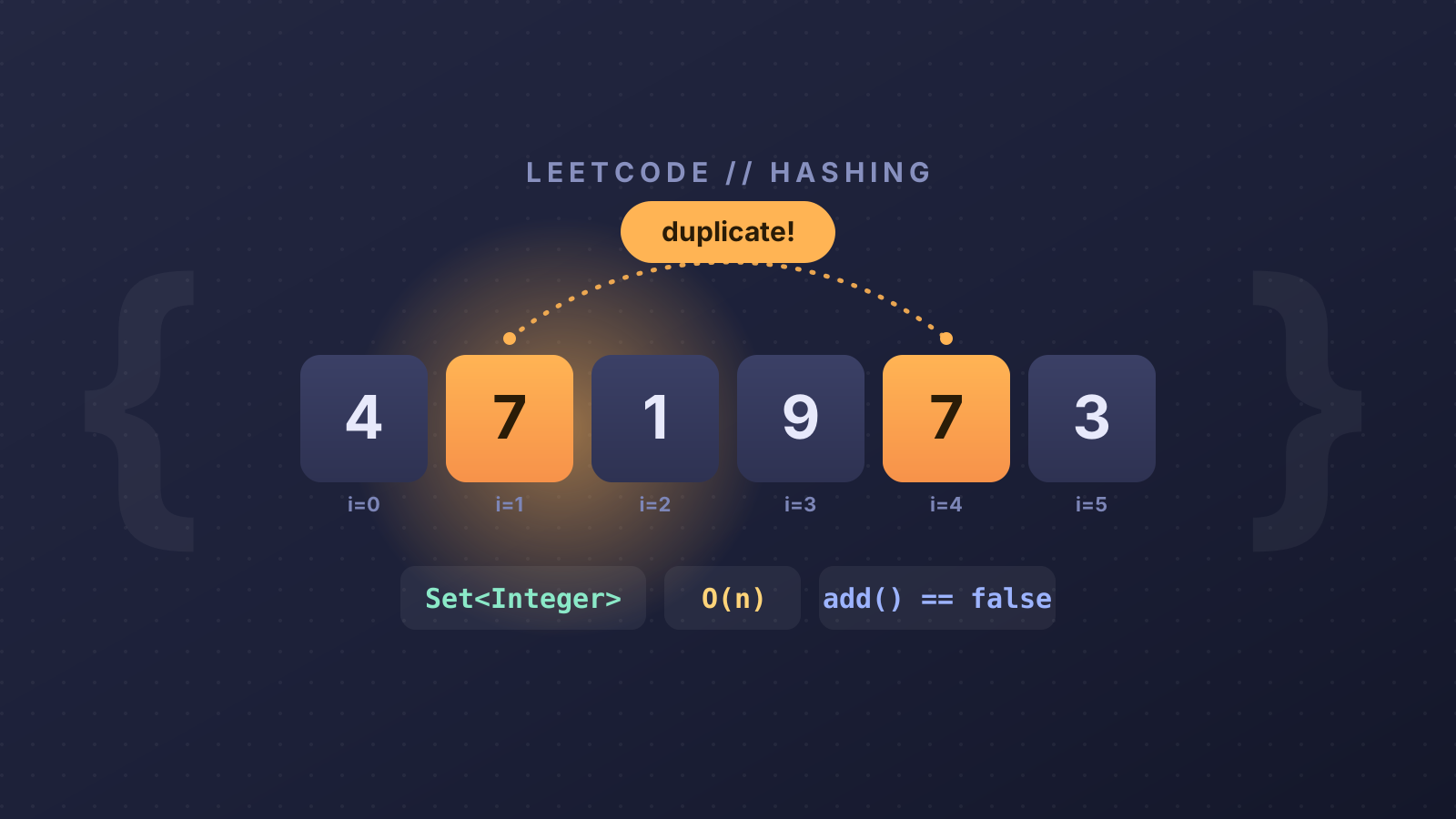
“Contains Duplicate” is one of the first entries in my running log of coding interview problems, which I keep while working through the Grind 75 and Neetcode Blind 75 study plans. It’s a five-minute problem on paper, but it’s worth slowing down on because the reasoning behind picking a hash set over sorting (or over sorting over brute force) is a template you’ll reuse constantly.
The problem
Given an integer array
nums, returntrueif any value appears more than once in the array, otherwise returnfalse.
Full statement on neetcode.io.
Input: nums = [1, 2, 3, 3]
Output: true

Input: nums = [1, 2, 3, 4]
Output: false
There’s no target index to return, no ordering to preserve — just a yes/no answer. That simplicity is what makes it a good vehicle for comparing approaches side by side.
Brute force: check every pair
The most literal reading of the problem is “for every element, look at every other element and see if any of them match”:
public boolean containsDuplicateBruteForce(int[] nums) {
    for (int i = 0; i < nums.length; i++) {
        for (int j = i + 1; j < nums.length; j++) {
            if (nums[i] == nums[j]) {
                return true;
            }
        }
    }
    return false;
}
The inner loop starts at i + 1 so we never compare an element with itself and never check the same pair twice, but we still do roughly n²/2 comparisons in the worst case (an array with no duplicates at all, so both loops run to completion). That’s O(n²) time. The only thing going for it is O(1) extra space — it reads directly from the input array and needs no auxiliary structure. Fine for a handful of elements, unusable once nums grows past a few thousand entries.
Sorting first
If we sort the array, any duplicate values are guaranteed to end up adjacent to each other, so a single linear pass over the sorted array is enough to catch them:
public boolean containsDuplicateSorting(int[] nums) {
    Arrays.sort(nums);
    for (int i = 1; i < nums.length; i++) {
        if (nums[i] == nums[i - 1]) {
            return true;
        }
    }
    return false;
}
This drops the time complexity to O(n log n) — the sort dominates, since the follow-up scan is only O(n) — and space stays O(1) if we don’t count what Arrays.sort uses internally for primitives (it’s an in-place dual-pivot quicksort for int[]). The catch is that it mutates the input array. If the caller still needs the original order afterwards, this approach silently breaks their code, which is a real cost even though it doesn’t show up in the Big-O.
The optimal approach: a hash set
Sorting is doing more work than the problem actually asks for — we don’t care about order, only about whether we’ve seen a value before. That’s exactly the question a set answers, and it answers it without needing to sort anything first.
Java’s HashSet.add() already returns false when the element you’re inserting is already present, so there’s no need to contains() then add() separately — one call gives you both pieces of information:
public boolean containsDuplicate(int[] nums) {
    Set<Integer> seen = new HashSet<>();
    for (int num : nums) {
        if (!seen.add(num)) {
            return true;
        }
    }
    return false;
}
We walk the array once. For each value, we try to add it to seen. If add() comes back false, that value was already in the set, so we’ve found our duplicate and can return immediately without looking at the rest of the array. If we make it to the end without a failed insert, every value was unique.
Why this is O(n)
A HashSet bucket-indexes elements by their hash code, so insertion and lookup are O(1) on average — computing hashCode() and jumping to a bucket doesn’t depend on how many elements are already stored. Across the whole array that gives O(n) total time, down from O(n log n) or O(n²).
“On average” matters here: if many values hash into the same bucket (a bad hash function, or an adversarial input), a single add() degrades toward O(n) and the whole loop toward O(n²) in the worst case. Integer.hashCode() is just the int value itself, which spreads well across buckets for typical inputs, so in practice you get the average case, not the pathological one.
Space is O(n) in the worst case: an array with no duplicates forces us to store every single element in the set before we can conclude there’s no match.
An even cheaper option, when it applies
If you know nums only contains values in a small, bounded range (say, 0–255, or ages, or anything with a known ceiling), you don’t need a hash function at all — a plain boolean[] indexed directly by value does the same job with no hashing overhead:
public boolean containsDuplicateBoundedRange(int[] nums, int maxValue) {
    boolean[] seen = new boolean[maxValue + 1];
    for (int num : nums) {
        if (seen[num]) {
            return true;
        }
        seen[num] = true;
    }
    return false;
}
Complexity-wise this is still O(n) time and O(k) space, where k is the size of the value range rather than the input — but array indexing has no collision handling and no boxing (no Integer autoboxing, unlike HashSet<Integer>), so it’s meaningfully faster in practice. This only works when the range is known and reasonably small; for arbitrary int values it’s obviously off the table.
Takeaway
Whenever a problem reduces to “have I seen this value before?”, reach for a hash-based structure by default — it turns nested loops or a sort into a single linear pass, at the cost of O(n) extra memory. But don’t stop there: if the values are bounded and known ahead of time, a plain array indexed by value beats hashing outright, because you skip the hash computation and collision handling entirely. Knowing when the cheaper structure applies is as valuable as knowing the hash set trick itself.